
Data centers have quickly become an important issue to voters in this election cycle. In a mid-September CNN poll, nearly two-thirds of registered voters said AI and data center development would be an important factor in their vote. Six in 10 Americans say they would be uncomfortable with a new data center in their area, while only about a quarter would be comfortable with it, according to Pew.
Opponents are concerned with environmental impacts, rising energy costs, and other impacts on their quality of life. Proponents focus on the potential benefits to local economies, but most people aren’t buying it. According to that same Pew survey, just 1 in 5 say data centers are mostly good for local jobs or local tax revenue. The skepticism crosses party lines, though Democrats feel it more strongly. Among Democrats, 68% say they’d be uncomfortable with a new data center nearby, compared with 54% of Republicans.
With that much public interest, you would think candidates would make their positions clear. To find out whether they are, we matched every 2026 U.S. House district against two data sets: Democracy Test Kitchen’s own collection of campaign-website statements from more than 1,000 House candidates, and data from Compute Atlas tracking data centers that are proposed, permitted, or under construction across the country. Most candidates, we found, aren’t talking about data centers at all, even where construction is planned or under way.
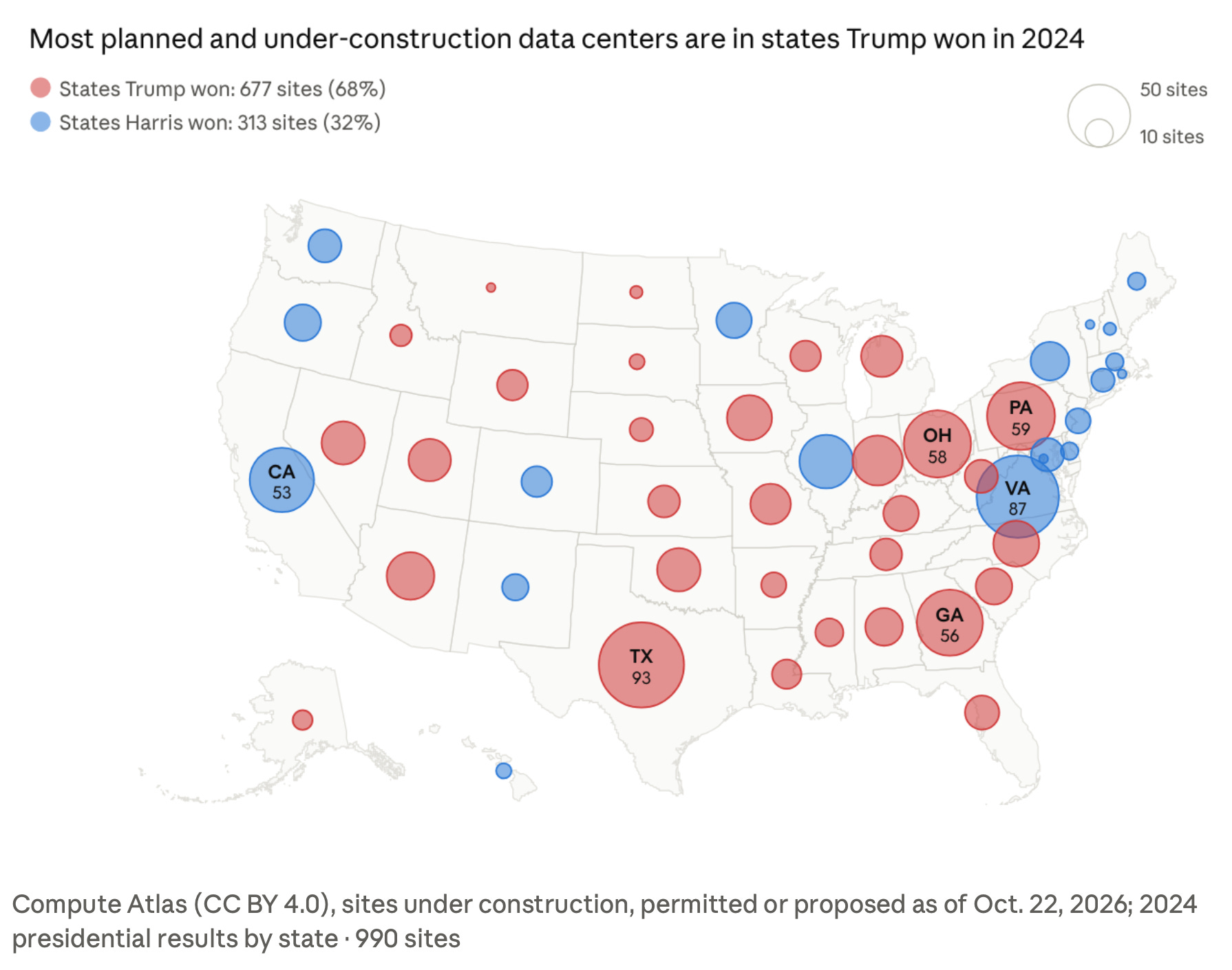
Development has shifted from blue states to red states
Historically, data centers were largely located in blue states. The New York–New Jersey region was the country’s largest data center market until 2016 [link], when Northern Virginia (another Democratic-leaning region) took the top spot.
Things have changed a lot since then. In the Compute Atlas data we use throughout this piece, 74% of data centers under construction and 67% of those permitted or proposed are in states Donald Trump won in 2024.
Built at home, but unmentioned on the trail
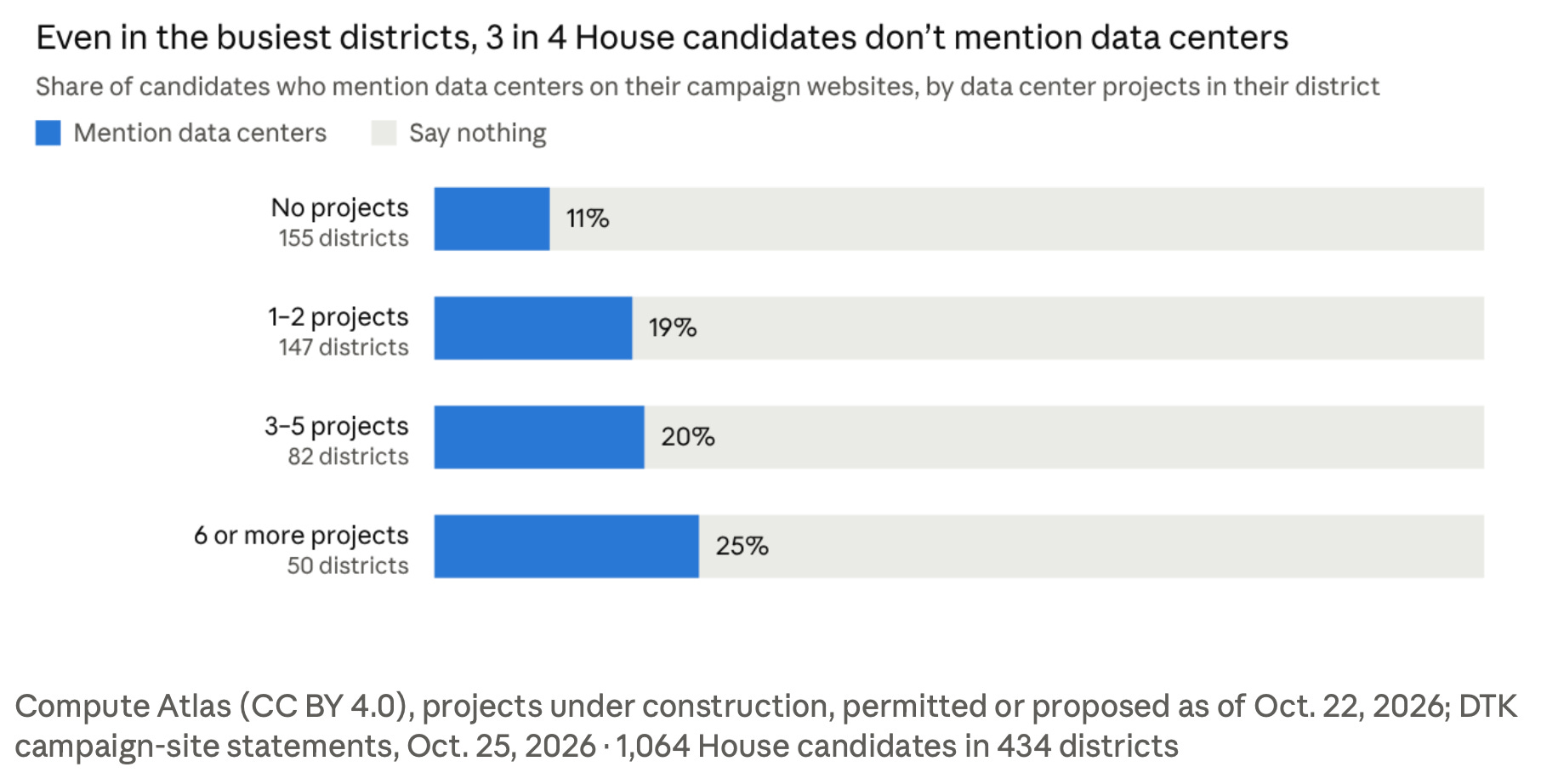
Only 1 in 5 House candidates in districts where data centers are being planned or built mention them on their campaign websites, and the silence isn’t limited to small projects. Some of the largest data centers in the country are going up in districts where campaign websites say nothing on the topic.
Take Texas’s 23rd District in West Texas. It has 10 data center projects in the pipeline. Yet neither major-party candidate mentions data centers on their campaign website.
Republican Brandon Herrera’s platform centers on border security and immigration, gun rights, abortion restrictions, and cutting federal spending. Democrat Katy Padilla Stout focuses on voting rights, reproductive rights, expanding Medicare, and public schools. The data center projects planned for their district don’t come up on their campaign websites. Herrera and Stout were nudged into the data center discussion recently during a live debate when the moderator asked them to outline their positions.
Silence in a heavily built district can be explained in more than one way. A candidate may address the issue in ads or debates (as did Herrera and Stout) rather than on a website, or they may see little to gain from engaging. Our data can’t tell those apart. But voters face the same result either way: the issue reshaping their community is hard to find on the candidates’ own platforms.
It’s not all quiet on the data center frontier. Virginia’s 7th District, for instance, has 30 projects, more than any other district in the country, and all three of its main candidates address data center development on their campaign websites. The Democratic incumbent, Eugene Vindman, is campaigning on making data centers “pay their fair share” and this month introduced the Make Data Centers Pay Act. Republican Doug Ollivant says growth must come with community buy-in, and Libertarian Taner Demirci Lopez would require a consent vote by directly affected property owners.
All talk, no development
The mismatch runs the other way, too. In nearly 1 in 5 districts with no tracked data center sites at all (14 of 73), a House candidate is campaigning on the issue.
In Florida’s 14th District in Tampa, Compute Atlas tracks no data center projects, yet both major-party candidates address them. Democratic Rep. Kathy Castor points to her Ratepayer Protection Act, which would require large power users such as data centers to cover the cost of the grid improvements they need. Her Republican challenger, Mike Beltran, pledges that no data center will be built “without local approval and a guarantee it won’t raise your energy bills or harm our environment.”
The two land in the same place: both frame data centers as a cost-of-living issue and want them to pay their own way, though Castor emphasizes federal rules on utility costs while Beltran emphasizes local approval. The race’s Libertarian, Brian Lambert, talks about energy more broadly, backing an all-of-the-above strategy and lower costs for families, but doesn’t mention data centers.
These candidates aren’t necessarily jumping on the bandwagon. A data center’s costs don’t stop at the district line. Power grids and utility rates are shared across whole regions, so a campus in one county can show up on electricity bills several counties away.
Pause, pay or stay quiet
Across the nearly 1,100 House candidates whose campaign statements we have, 83% say nothing about data centers. The 183 who do mention them fall into three camps, and almost none are campaigning for more data centers:
Allow with conditions (61%): Make data centers pay their own energy and grid costs, give communities the final say, protect water, and end tax breaks. “Data centers must pay their fair share to connect to and use the grid,” writes Democratic Rep. Rick Larsen of Washington. Republican Rep. Derrick Van Orden of Wisconsin says data center development “should not be imposed on communities without local input or consent.”
Oppose or pause (31%): A moratorium until protections are in place, or a flat no. “No more data centers,” reads Georgia Democrat Amanda Hollowell’s site. Massachusetts Republican R. Tyler Macallister wants “no data centers draining our grid and our water.”
Supportive (3%): Faster approvals and more power supply. California Republican Ritesh Tandon would set firm timelines for federal approvals of data centers and grid upgrades.
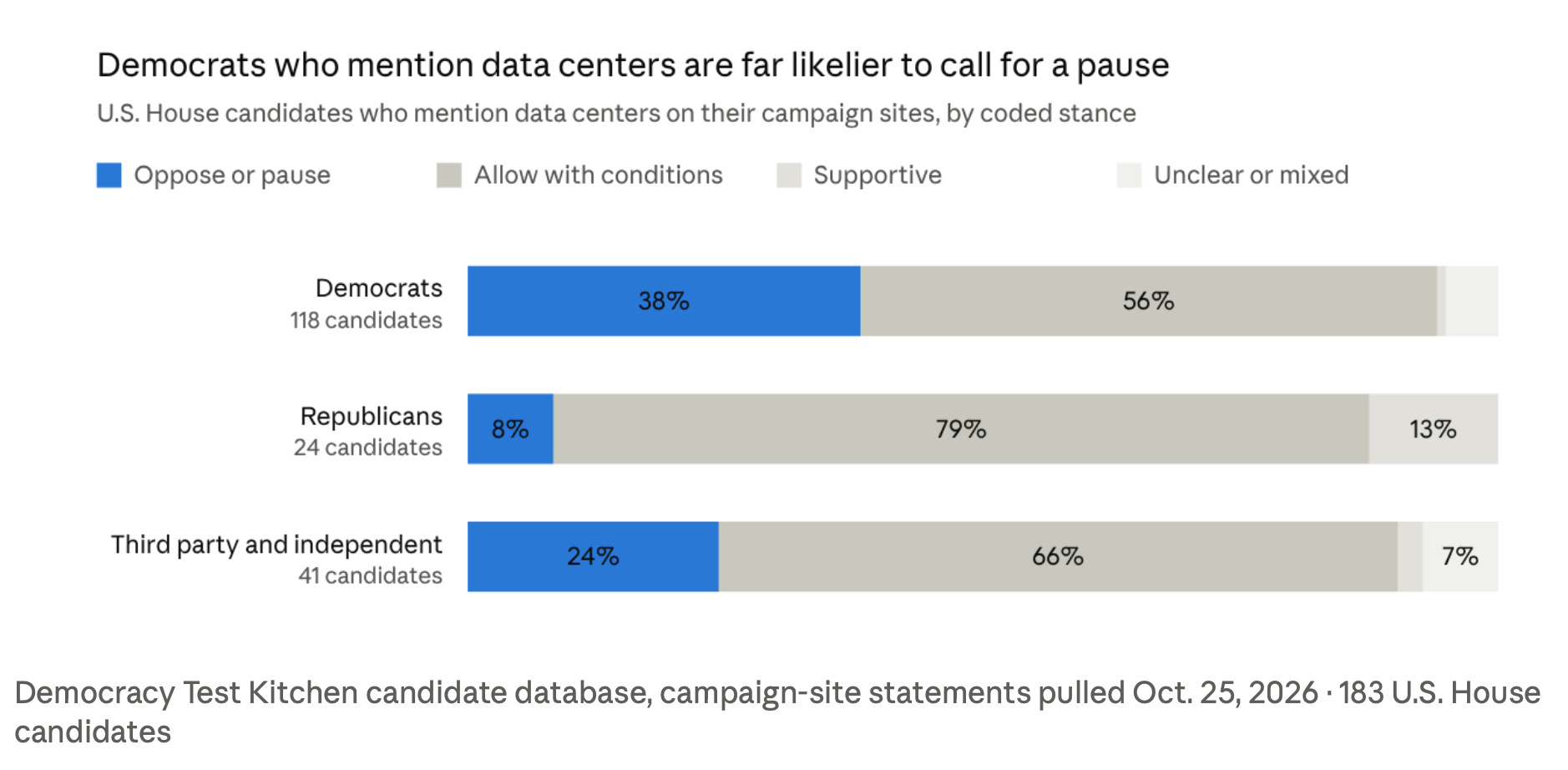
Democrats are far more likely to raise the issue on their campaign websites: 27% of Democratic House candidates with campaign statements on file mention data centers, compared with only 6% of Republicans. When they do, Democrats are split between pausing construction and setting conditions. Republicans overwhelmingly focus on conditions (19 of 24), like local control and protecting ratepayers. House Majority Leader Steve Scalise of Louisiana argues that local communities, not Washington, should decide whether to welcome data centers.
The overlap may matter more than the differences. Vindman’s bill would keep data centers’ electricity costs off household bills, and Republican Reps. Mike Flood of Nebraska and Riley Moore of West Virginia cosponsor bills with the same aim.
Real head-to-head debates are rare. Of the 434 House races we tracked, just nine have both a Democrat and a Republican talking about data centers. In five of those, the Democrat would stop or pause construction while the Republican would let communities set the terms. In Pennsylvania’s 8th District, with 14 projects in the pipeline, Democrat Paige Cognetti says “not one of these proposed data center projects should move forward,” while Rep. Rob Bresnahan has a bill to put data center decisions in local hands. In three races, including Virginia’s 7th, both sides call for conditions. And in Michigan’s 11th, the usual split flips: Republican Ethan Baker calls for a moratorium, while Democrat Jeremy Moss wants local control and protections for ratepayers.
For most voters, then, the data center debate is happening around them rather than on the ballot in front of them. In districts like Texas’s 23rd, where projects are planned but campaign websites are silent, finding out where candidates stand may mean asking them directly at a town hall, a debate or a campaign stop. On an issue that could shape local land use and utility bills for decades, a candidate’s silence is worth noticing, and worth questioning.
About the data: Candidate positions come from Democracy Test Kitchen’s collection of campaign-website statements from 1,064 general-election House candidates, pulled Oct. 25, 2026; a few positions come from candidates’ official congressional websites. Data center projects under construction, permitted or proposed come from Compute Atlas (CC BY 4.0) and were assigned to 2026 House districts using Census Bureau boundaries.