
Voters handed Democrats control of both chambers by a wide margin. The economy was the top issue for 39% of voters, according to the NBC News Exit Poll, and nearly 9 in 10 said they were concerned about grocery prices. Democratic leaders made costs one of the three pillars of their campaign message: “costs, chaos, and corruption.” But what did the winning candidates themselves emphasize, and what did they promise to do once in office?
We used Democracy Test Kitchen’s collection of campaign-website statements to understand what newly elected officials said they would do, what they’re aligned on, and what set the winners apart from the candidates they defeated.
Cost of living was indeed the common thread
Rather than being its own issue, cost of living came up across nearly every type of campaign messaging. More than three in four winners took a position on at least one cost of living issue (such as health care or energy prices). Very few winners talked about prices in the abstract. Instead, they focused on specific bills related to health insurance, housing, child care, and tariffs.
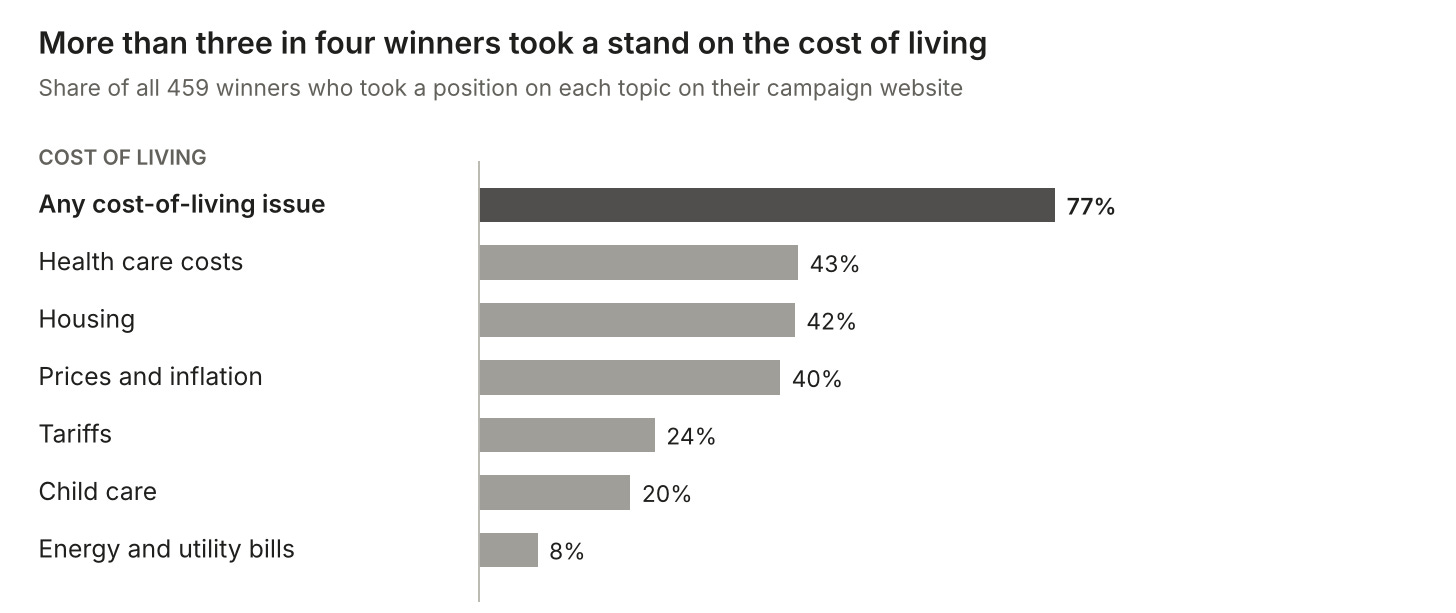
Both parties focused on cost of living, though not evenly: 92% of Democratic winners and 54% of Republican winners took a position on at least one cost-of-living issue.
Health care is the single biggest issue for the incoming class. On average, health care accounted for about 20% of total messaging on winners’ campaign websites. Economy, jobs, and taxes accounted for about 16% of winners’ messaging.
Talking about the economy may also have helped at the ballot box. Among races decided by less than 10 points, winners talked more about the economy, jobs, and taxes than losing candidates of their own party.
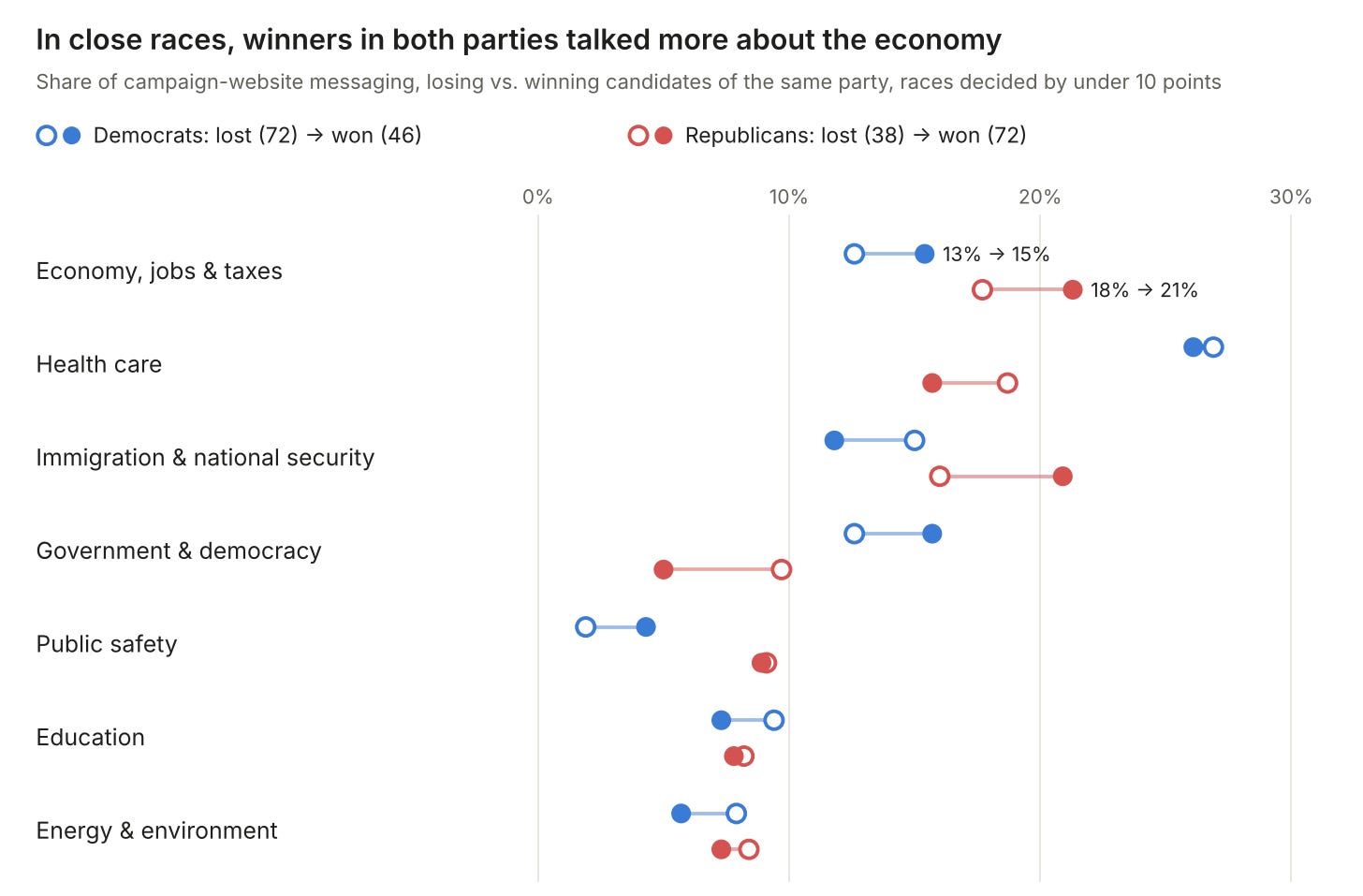
What candidates promised, by contrast, didn’t separate winners from losers. In those same races, winners and losers of the same party took nearly identical positions. Every Democrat who addressed Medicaid funding, the ACA credits, Medicare drug-price negotiation, or the minimum wage supported them, win or lose, and Republicans were just as uniform on taxes, guns, and defense.
But will they agree on how?
Agreeing that prices matter is not the same as agreeing on how to bring down the cost of living. Each specific fix drew a stated position from only a slice of the class.
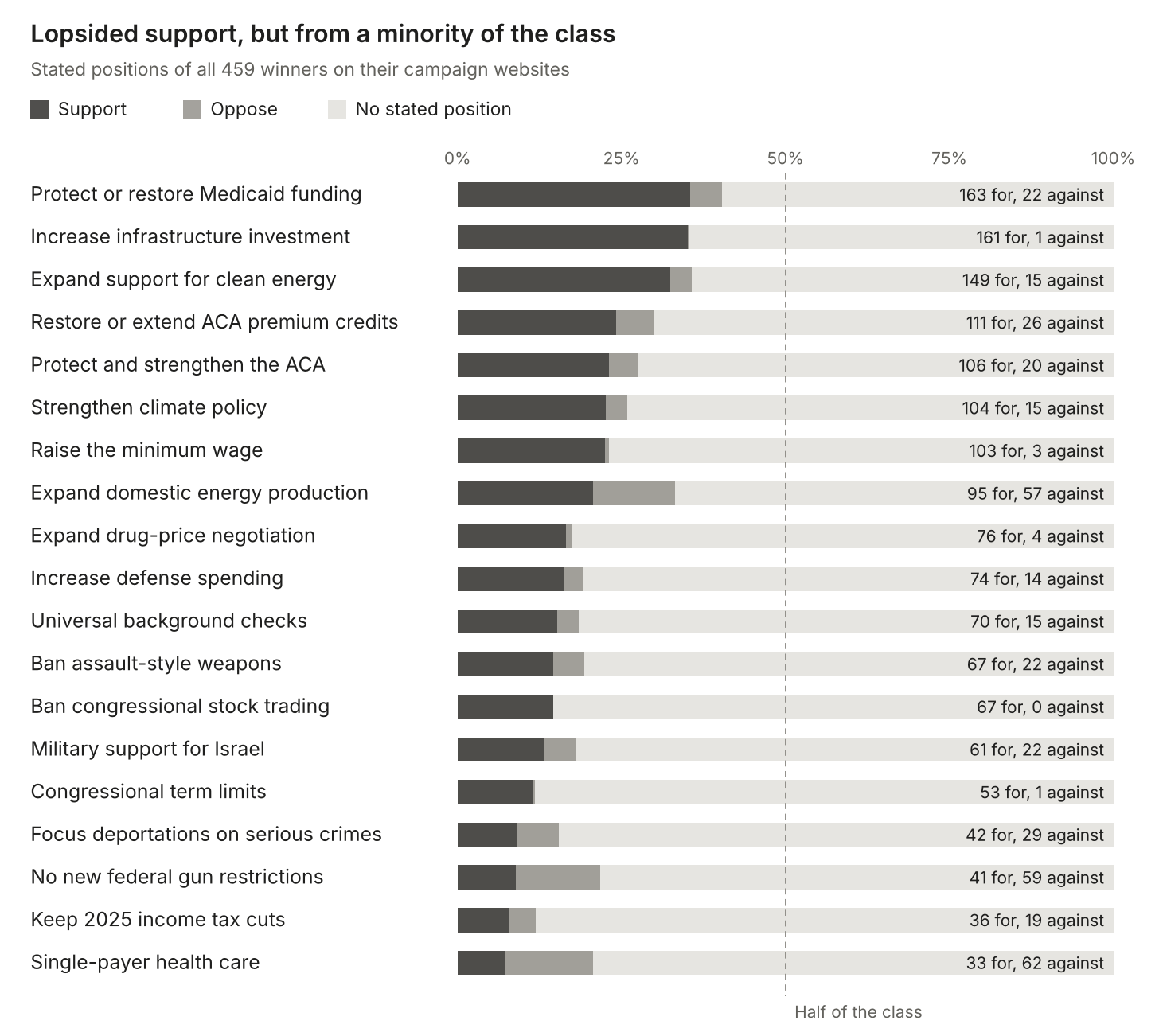
No more than about two in five winners took a stand on any single policy. Even the most widely addressed position, protecting or restoring Medicaid funding, drew stated support from only 36% of winners (5% opposed it, and the rest didn’t address it on their website). Silence was more common among Republicans, who listed about 18 positions each to Democrats’ 32, so the support shown here leans toward Democratic priorities.
Among winners who did take a position, a handful of policies drew near-unanimous support. Over 90% of them backed raising the minimum wage, expanding Medicare’s power to negotiate drug prices, investing in infrastructure, and supporting clean energy.
The most widely shared promises were concrete. Iowa’s Josh Turek, who flipped a Senate seat, promised to “restore full funding for Medicaid” for 110,000 Iowans he said were at risk of losing coverage. Texas’s James Talarico pledged to reverse cuts to the ACA’s premium credits, Medicare, and Medicaid.
Where the class is divided and united
From a party perspective, alignment within the incoming class falls into three buckets. In the first bucket, the class is divided along party lines. On the ACA credits, gun restrictions, and the 2025 tax cuts, nearly every winner who took a position sided with their party, and Medicaid funding came close.
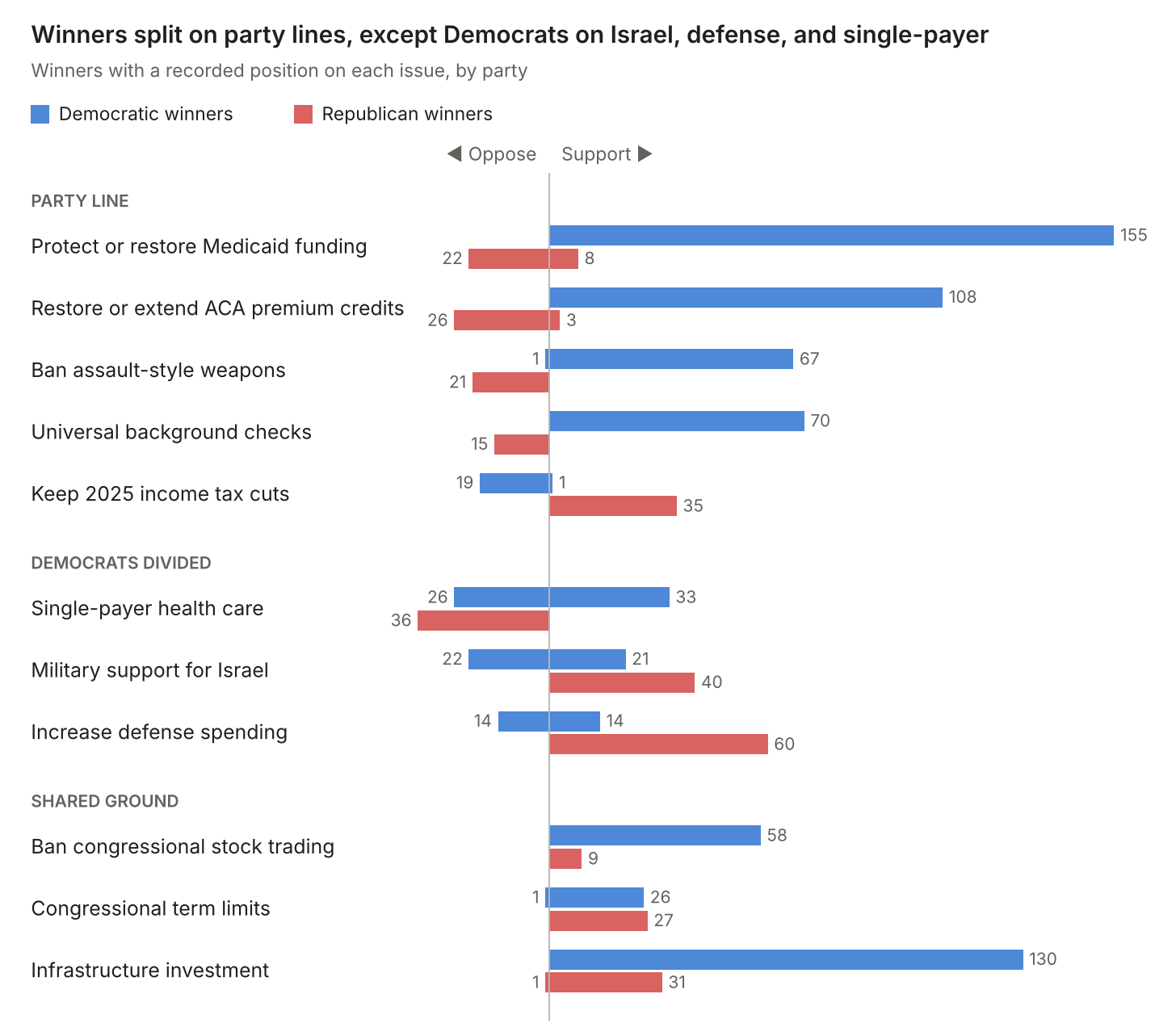
In the second bucket, it’s Democratic winners who are divided while Republican winners are on the same page. Democratic winners are split on military support for Israel, higher defense spending, and single-payer health care.
The third bucket offers some opportunity for bipartisan legislation. The incoming class shares ground on three issues: banning congressional stock trading, congressional term limits, and infrastructure investment. “No one – NO ONE – who serves in Congress, or their spouse, should be able to trade stocks,” Ohio’s Sherrod Brown writes on his site.
Republicans make the same case. Louisiana’s Julia Letlow, elected to the Senate, lists a pledge to “ban Members of Congress from trading individual stocks.” On term limits, Florida Republican Jim Schwartzel, newly elected in the 19th District, says it’s time to “break up the ruling class,” while Pennsylvania Democrat Janelle Stelson, who flipped the 10th District, pledged she “will not serve more than 12 years” whether or not Congress acts. California Democrat Jimmy Panetta pitches infrastructure as a cost-of-living issue, promising federal investment in roads, rail, and water systems to bring down prices at grocery stores and gas stations.
What this class is positioned to do
Read one promise at a time, the incoming class looks scattered. Read together, the story looks a bit more promising. More than three in four winners, including about half of Republican winners, took a position on at least one cost-of-living issue, whether health insurance, housing, child care, energy prices, or tariffs. That gives the most popular cost-cutting promises, like letting Medicare negotiate more drug prices, raising the minimum wage, and restoring Medicaid funding, a much larger potential base of support than their individual counts suggest. A member who campaigned on lowering housing costs has already told voters that prices are the priority, even on bills their website never mentioned.
The hardest part is that the class’s most widely addressed promise, restoring Medicaid funding, needs the president’s signature. As CNN noted, lower prices can’t be legislated over a veto. The promises are now on the record, and the cost-of-living ones, like lower drug prices, will be the easiest to measure this Congress against.
About the data: Candidate positions and issue emphasis come from Democracy Test Kitchen’s collection of campaign-website statements from 1,252 general-election House and Senate candidates, as of Nov. 10, 2026; a few positions come from candidates’ official congressional websites. Emphasis is each candidate’s share of messaging by issue area. Stance figures include only medium- or high-confidence positions, and each policy groups the different wordings used across states, with opposite-direction wordings counted as opposition. Winners follow AP race calls as of Nov. 16; the 10 House races and one Senate race still uncalled are excluded. Close races are those decided by under 10 points in Democracy Test Kitchen’s vote totals. Exit poll figures are from NBC News.