

A slim majority (53%) say they are satisfied with the two-party system, but only 18% are “very satisfied.” The internals read more like resignation than support.
82% of Americans are familiar with the term “gerrymandering,” and 67% call it a “major problem” in U.S. elections today.
Roughly half of adults believe one party has a built-in advantage in their U.S. House, state senate, and state house districts, a perception that tracks reality.
Redistricting reform moves on a long time horizon. Strategic voting — and tools like Democracy Test Kitchen — is a lever voters can pull now.
The American voter appears clearly dissatisfied with the country’s political system. Public discourse centers around historic lows in public trust, the perception that neither party adequately represents voters’ true political preferences, and the feeling that an individual’s vote really doesn’t matter. In an increasingly saturated online environment, however, it can be difficult to discern the true boogeyman of voters’ discontent — an essential job for prescribing the correct set of solutions.
A new national online survey of 1,007 qualified U.S. adults shines empirical light on this discussion: Americans have begrudgingly accepted a two-party reality, but are increasingly unsatisfied with legislative redistricting efforts and perceived built-in party advantages.
Thanks for reading Sam Publication! Subscribe for free to receive new posts and support my work.
Two-Party Tolerance
At first look, the 53% of respondents who are satisfied with two-party choices (18% “very satisfied,” 35% “somewhat satisfied”) compared to 47% dissatisfied is surprising. Widely cited national research consistently points to voter dissatisfaction with the American political system: Pew Research Center data report that 63% of Americans have little or no confidence in the future of the political system.
Once we break the 53% figure down, however, it reads less like enthusiastic support and more like passive acceptance. Just 18% are “very satisfied,” while the vast majority of respondents occupy a lukewarm middle — 35% “somewhat satisfied” and another 26% “somewhat dissatisfied” — with 21% “very dissatisfied.” Voters, it seems, view the current two-party system as an imperfect but ultimately necessary vessel for American politics.
Gerrymandering Disdain
While voters are largely tolerant of the existing two-party system, sentiment towards district line-drawing is overwhelmingly negative. 82% of respondents have prior familiarity with the term “gerrymandering” — a word that used to reside mostly in wonkish political science circles.
Most notably, when provided with the definition describing district boundaries drawn to favor one party over another, 67% of qualified adults call gerrymandering a “major problem” in U.S. elections, with another 19% calling it a “minor problem.” Only 4% say it is “not a problem,” while 10% remain unsure. Taken together, these results are a clear rebuke of partisan gerrymandering, and they corroborate other recent polling — including YouGov’s April 2026 survey finding that 71% of Americans say partisan gerrymandering should not be allowed.

A Captured Country
To measure how voters experience the effects of electoral boundaries locally, the survey asked respondents whether one political party has a built-in advantage in their U.S. House, state senate, and state house districts. Nearly half of American adults view their local legislative seats as structurally safe for one party — 50%, 47%, and 46% across the three legislative levels. Roughly a third call those seats competitive; 16% to 19% are unsure.
These perceptions track reality. MultiState reported that only 19% of the state legislative seats up for election in 2024 were rated even somewhat competitive, and the Cook Political Report rated 369 of 435 U.S. House seats (85%) as “solid” in 2026. Many Americans view their vote as functionally meaningless in state and federal elections, and in general elections, that sense of powerlessness is often justified. We are left asking: how can we give voters some power back?
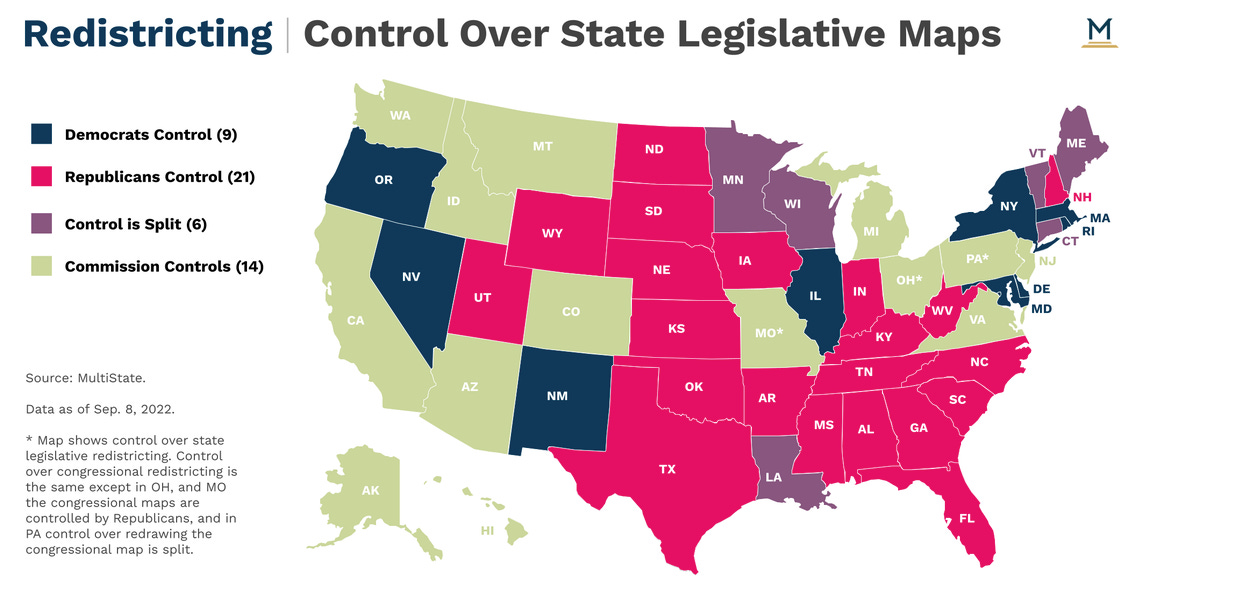
From Structural Revolt to Strategic Choices
Taken together, the survey reveals a clear diagnostic. While there is widespread frustration with the two-party system generally, voter dissatisfaction is far more concentrated when it comes to the effects of partisan gerrymandering. That distinction matters when we turn to solutions. Broad tolerance of the two-party system casts doubt on the feasibility of a widely supported third-party revolt; solutions aimed at making districts more competitive are more likely to find broad buy-in with the American electorate.
Comprehensive redistricting reform, however, moves on a long time horizon. In the near term, we are left looking for practical tools that put more power back in voters’ hands under the existing electoral map.
Enter strategic voting. A strategic vote is any vote an individual takes specifically to maximize the likelihood of influencing an election’s outcome — for instance, a supporter of the minority party voting for their least objectionable candidate in the majority party’s primary, on the assumption that the majority party’s nominee will hold the seat regardless.
Tools like Democracy Test Kitchen (DTK) offer a promising path ahead. DTK provides data-driven insights that make a voter’s ballot more legible — ranking candidates by inferred ideological match with the user and recommending where an individual’s vote can be most powerful. DTK has been rolled out this cycle in two critical primary battlegrounds — Michigan (open primary) and Florida (closed primary) — helping voters make the most of their votes regardless of the primary rules in place.
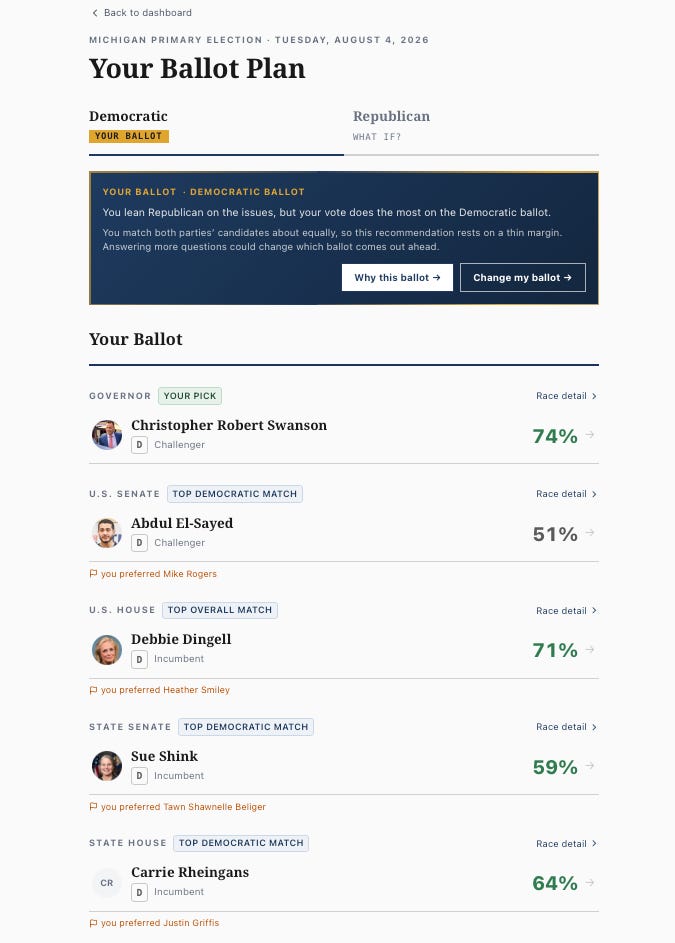
If half the country believes their legislative districts are effectively captured, how many voters are ready to vote strategically inside primary elections? The next article in this series will examine that question through additional survey findings on strategic primary voting.
*Follow DTK on Instagram at @democracytestkitchen and visit democracytestkitchen.com for more.*
*About the data: A national online survey of 1,007 qualified U.S. adults fielded in June 2026. To correct for online panel skews, post-stratification weights were constructed by iterative proportional fitting (raking) to U.S. Census Bureau benchmarks for adults 18+ across gender, age brackets, and the nine Census geographic divisions. The weighted sample of 1,007 has a design effect of 1.18 and an effective sample size of ~855, yielding a margin of error of ±3.1 percentage points at the 95% confidence level for full-sample toplines.*